Open any weight loss calculator and it will ask for your goal weight, punch in some numbers, and tell you something like: "At a deficit of 500 kcal/day, you'll reach your goal in 14 weeks." Sounds clean. Sounds achievable. And in most cases, it's wrong.
Not because the math is bad in principle, but because the human body is not a spreadsheet. Your metabolism adapts. Your hunger hormones shift. The composition of the weight you lose changes over time. The tidy linear projection the calculator shows you diverges from reality by week three and keeps diverging.
The result is predictable: people set a target date, miss it, feel like they've failed, and quit. Research confirms this pattern. A study modeling weight loss dynamics found that the classic "3,500-kcal rule" — cut 500 kcal/day, lose one pound per week — consistently overestimates actual weight loss because it ignores the body's metabolic response to energy restriction.
This article covers what the evidence actually says about setting weight loss goals: how fast you can safely lose weight, how to estimate the deficit you need, what happens when you push too hard, and how to protect the muscle you want to keep. The goal is to replace the spreadsheet fantasy with a framework that works in a living body.
The 3,500-Calorie Rule: Useful Shorthand, Terrible Prediction
Since the 1950s, a simple rule has dominated weight loss advice: one pound of body fat stores approximately 3,500 kcal of energy, so a daily deficit of 500 kcal should produce one pound of loss per week. The rule traces back to Max Wishnofsky's 1958 calculation, and it's still printed in patient handouts, fitness apps, and clinical brochures.
The problem is that this rule treats the body as a closed container that burns fuel at a fixed rate. It isn't. A systematic analysis published in the International Journal of Obesity dissected why the 3,500-kcal rule fails. The authors identified three critical errors:
- It assumes linear weight loss. In reality, weight loss follows a curve — rapid early loss that gradually slows as the body adapts.
- It ignores metabolic adaptation. As you lose weight, your resting energy expenditure drops — both because you are smaller and because of adaptive thermogenesis (your body actively down-regulating metabolism beyond what size alone would predict).
- It treats all weight loss as fat. Early weight loss includes significant water and glycogen. The energy content of weight lost changes over time.
Dynamic mathematical models developed at the NIH account for these factors and produce curvilinear projections that match real-world data far more closely. In validation studies, the NIH Body Weight Planner predicted actual weight change with a mean bias of just -0.4 kg, compared to 4.7 kg of overestimation from simpler models.
The practical takeaway: the 3,500-kcal rule gives you a reasonable starting point for your deficit, but the timeline it implies is almost always too optimistic. Expect weight loss to slow over time, and plan for it.
TDEE: The Number That Actually Matters
Before you can create a deficit, you need to know what you're creating a deficit from. That number is your Total Daily Energy Expenditure, or TDEE — the total amount of energy your body burns in a day.
TDEE has three components:
- Basal Metabolic Rate (BMR): The energy your body uses at complete rest to maintain basic functions — breathing, circulation, cell repair. This accounts for 60–75% of total expenditure.
- Thermic Effect of Food (TEF): The energy cost of digesting, absorbing, and processing food. Roughly 10% of total expenditure.
- Physical Activity Energy Expenditure (PAEE): Everything from structured exercise to fidgeting and walking to the kitchen. This is the most variable component, ranging from 15–30% of total expenditure.
The standard approach is to estimate BMR using a validated equation, then multiply by an activity factor to approximate TDEE:
| Activity Level | Multiplier |
|---|---|
| Sedentary (desk job, little exercise) | 1.2 |
| Lightly active (light exercise 1–3 days/week) | 1.375 |
| Moderately active (moderate exercise 3–5 days/week) | 1.55 |
| Very active (hard exercise 6–7 days/week) | 1.725 |
| Extremely active (physical job + intense training) | 1.9 |
The activity multiplier is the weakest link in the chain. Most people overestimate their activity level by at least one category. If you sit at a desk for 8 hours and do a 45-minute gym session three times per week, you're "lightly active" — not "moderately active." This single miscategorization can throw your TDEE estimate off by 200–300 kcal/day, which is enough to eliminate half your planned deficit.
The Mifflin-St Jeor Equation: Why It's the Gold Standard
Several equations exist for estimating BMR. The one with the strongest evidence behind it is the Mifflin-St Jeor equation, published in 1990 based on indirect calorimetry measurements from 498 healthy adults:
For men: BMR = (10 x weight in kg) + (6.25 x height in cm) - (5 x age in years) + 5
For women: BMR = (10 x weight in kg) + (6.25 x height in cm) - (5 x age in years) - 161
A systematic review by the American Dietetic Association compared the Mifflin-St Jeor equation against the Harris-Benedict, Owen, and WHO/FAO/UNU equations in both non-obese and obese adults. The Mifflin-St Jeor equation was the most reliable across populations, predicting resting metabolic rate within 10% of the measured value in approximately 82% of non-obese individuals and 70% of obese individuals — better than any competing equation.
The equation has a standard error of about 10%, which means that for any given person, it could be off by roughly 150–200 kcal in either direction. That's important to understand: this is an estimate, not a measurement. Your actual BMR could be higher or lower depending on genetics, muscle mass, thyroid function, and other factors the equation doesn't capture.
This is why tracking real-world weight changes over 2–3 weeks is essential for calibrating your deficit. The equation gives you a starting point; your scale data tells you whether the starting point was accurate.
The Safe Zone: 0.5–1 kg Per Week
The NHLBI Clinical Guidelines on Obesity — the foundational reference for evidence-based weight management — recommend a rate of weight loss of 0.5 to 1 kg per week (roughly 1 to 2 pounds), achieved through a daily caloric deficit of 500 to 1,000 kcal. This recommendation carries an Evidence Category A rating, the highest level of clinical confidence.
This range didn't emerge from a single study. It's the convergence of decades of clinical trials showing that deficits within this range produce meaningful fat loss while minimizing three serious risks:
1. Muscle Loss
When you restrict calories, your body doesn't exclusively burn fat. Some of the weight you lose is lean tissue — including muscle. The faster you lose, the more muscle goes with it. A meta-analysis comparing gradual versus rapid weight loss found that while total weight lost was similar between approaches, gradual weight loss produced significantly greater reductions in fat mass and body fat percentage. In elite athletes, a slow reduction group (0.7% of body weight per week) gained 2.1% in lean body mass, while a fast reduction group (1.4% per week) saw no lean mass change — effectively wasting the same effort with worse body composition.
On average, 24% of weight lost through diet alone comes from lean tissue. Adding exercise reduces this to about 11%, but the rate of loss still matters.
2. Gallstone Formation
This risk is underappreciated. A landmark study on rapid weight loss found that 10–25% of obese individuals develop gallstones within a few months of starting a very-low-calorie diet, and about one-third of those become symptomatic. The identified threshold: a rate of weight loss exceeding 1.5 kg per week significantly increases gallstone risk. Staying within the 0.5–1 kg/week range keeps you below this danger zone.
3. Metabolic Adaptation
Your body responds to caloric restriction by reducing energy expenditure — a phenomenon called adaptive thermogenesis. A study of participants from The Biggest Loser competition found that metabolic adaptation persisted 6 years after the competition ended: their resting metabolic rates were, on average, 500 kcal/day lower than expected for their body size. The more aggressive the deficit, the stronger this response. Moderate deficits trigger less dramatic adaptation, preserving more of your metabolic capacity.
Protecting Your Muscle: Protein and Resistance Training
Losing weight is easy. Losing fat while keeping muscle is the actual challenge. Two interventions have strong evidence for preserving lean mass during a deficit:
Higher Protein Intake
The standard Recommended Dietary Allowance for protein is 0.8 g/kg/day, which is adequate for sedentary individuals maintaining their weight. But during caloric restriction, protein needs increase substantially.
A randomized trial published in the American Journal of Clinical Nutrition compared two groups in a 40% caloric deficit with intensive exercise: one consuming 1.2 g/kg/day of protein, the other consuming 2.4 g/kg/day. The high-protein group gained 1.2 kg of lean body mass while losing 4.8 kg of fat. The lower-protein group lost 1.5 kg of fat but gained no lean mass — same deficit, dramatically different body composition outcomes.
Current evidence-based recommendations for protein during weight loss range from 1.6 to 2.4 g/kg/day for active individuals, scaling upward with the severity of the deficit and the individual's leanness. For most people pursuing moderate weight loss, 1.6–2.0 g/kg/day is a practical target.
Resistance Training
Cardio burns calories during the session. Resistance training preserves the metabolic engine that burns calories the rest of the time. A systematic review and meta-analysis found that adding resistance training to caloric restriction maintained lean mass (mean change of approximately -0.3 kg, not statistically significant), while groups without resistance training lost substantially more lean tissue.
The evidence is unambiguous: during a caloric deficit, resistance training 2–4 times per week is the single most effective intervention for ensuring that the weight you lose is predominantly fat. Without it, you may reach your goal weight but with a worse body composition than when you started — less muscle, relatively more fat, and a lower resting metabolic rate.
The Gap Between Projections and Reality
Even with accurate TDEE estimates and a well-calibrated deficit, real-world weight loss rarely matches the projection. Several factors conspire to widen the gap:
Metabolic adaptation slows you down. As you lose weight, your BMR drops — both because you are physically smaller (a predictable, calculable reduction) and because of adaptive thermogenesis (an additional 5–15% reduction that the body imposes beyond what size alone explains). A review in the American Journal of Clinical Nutrition confirmed that declines in energy expenditure favoring weight regain persist well beyond the period of active weight loss.
Compliance drifts. No one maintains a perfect deficit indefinitely. Social meals, holidays, stress eating, inaccurate food logging — these introduce real variance. Clinical trials with tightly controlled diets still see individual variation of 20–30% in actual versus predicted weight loss.
Water weight masks fat loss. You can lose 0.5 kg of fat in a week and see the scale go up because your body retained water from a high-sodium meal, intense exercise, hormonal shifts, or cortisol. This is why trend-based tracking (7-day moving averages rather than daily readings) is essential — a point we covered in depth in our article on weight tracking science.
Body composition changes over time. Early in a deficit, you lose a mix of water, glycogen, fat, and some lean tissue. As weeks pass, the proportion shifts more toward fat — but the total rate slows. A study of energy content during voluntary caloric restriction confirmed that the energy value of each kilogram lost increases over time, meaning later kilograms take a larger cumulative deficit to lose.
The honest framing: if you calculate a 12-week timeline to your goal, budget for 16–20 weeks. Not because you're doing something wrong, but because biology is not arithmetic.
From Theory to Practice: How WatchMyHealth Builds This In
The science above isn't just background reading — it's built into how WatchMyHealth handles weight goals.
TDEE and caloric needs calculation. The app uses the Mifflin-St Jeor equation with your profile data (weight, height, age, sex, activity level) to estimate your BMR and TDEE. From there, it calculates the daily caloric target needed to reach your goal at a safe rate. You don't need to run the equations yourself.
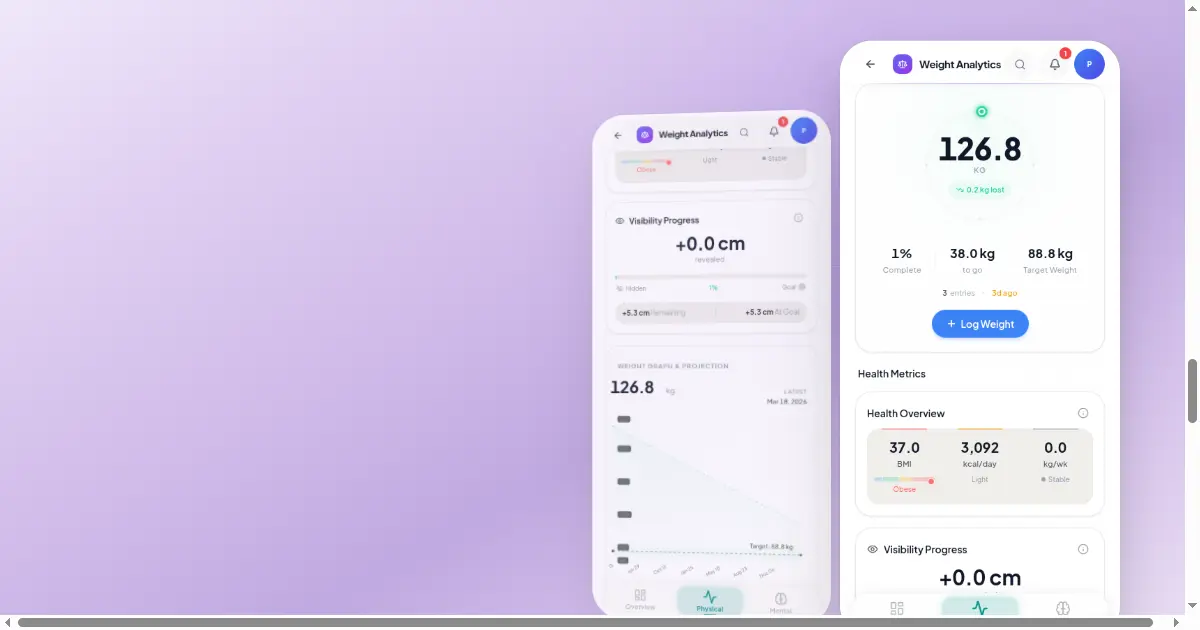
Goal tracking with a progress ring. Your weight goal appears as a visual progress ring that fills based on your 7-day moving average — not daily readings. This means the progress indicator reflects your real trend rather than daily noise. The ring gives you an intuitive sense of how far you've come without rewarding water fluctuations.
Adaptive weight projections. Rather than plotting a straight line from your current weight to your goal, the app's projection adapts to your actual rate of change. If you're losing 0.6 kg/week instead of the initially estimated 0.8, the projected date adjusts. If you hit a plateau, the projection reflects that too. This is designed to prevent the "I should be at 75 kg by now but I'm at 78" frustration that drives people to give up.
Rate-of-change monitoring. The app calculates your weekly rate of loss from trend data. If your rate exceeds 1 kg/week consistently, you can see it — and make an informed decision about whether to ease back. If your rate drops to near zero for two or more weeks, you know it's time to reassess your deficit, not your willpower.
The underlying philosophy is simple: give people accurate expectations, show them real progress, and remove the gap between what they think should happen and what their body is actually doing. That gap is where most goals die.
Setting Your Goal: A Practical Framework
Putting it all together, here's an evidence-aligned protocol for setting a weight loss goal that has a realistic chance of surviving contact with your biology:
- Estimate your TDEE using the Mifflin-St Jeor equation plus an honest activity multiplier. When in doubt, choose the lower activity level.
- Set your deficit at 500 kcal/day as a starting point. This targets approximately 0.5 kg/week of loss — the lower end of the recommended range, and the most sustainable.
- Track your weight daily, but evaluate weekly. Use a 7-day moving average. Compare weekly averages, not daily readings.
- Calibrate after 2–3 weeks. If your trend shows faster loss than 1 kg/week, your deficit may be too aggressive. If no movement, your TDEE estimate may have been too high.
- Prioritize protein at 1.6–2.0 g/kg/day, and perform resistance training 2–4 times per week to preserve lean mass.
- Add 30–50% to your estimated timeline. If the math says 12 weeks, plan for 16. This isn't pessimism — it's accuracy.
- Set process goals alongside outcome goals. "Log my weight every morning" and "hit my protein target 5 days this week" are within your control. "Lose 0.5 kg this week" is not — your body decides the actual number.
The best weight loss goal is not the most ambitious one. It's the one you're still following three months from now. The evidence consistently shows that moderate, sustained deficits produce better long-term outcomes than aggressive short-term pushes — in fat loss, in muscle preservation, and in the likelihood that you keep the weight off once you get there.