You ate pizza last night. Maybe you had a beer with it, maybe some garlic bread on the side. You woke up this morning, stepped on the scale, and it read almost a kilogram higher than yesterday. Your first thought: I ruined everything.
You didn't. What you're seeing is water weight — one of the most misunderstood phenomena in health and fitness. The human body can shift 1-2 kg (2-4 lbs) overnight without gaining or losing a single gram of fat. That pizza dinner triggered at least three simultaneous mechanisms: glycogen replenishment with bound water, sodium-driven fluid retention, and the simple physical mass of food sitting in your digestive tract.
This isn't a fringe claim. The physiology of water weight is documented across decades of research in metabolism, exercise science, and clinical nutrition. Understanding it is the difference between panicking at a number and knowing exactly what your body is doing.
Let's trace every pathway that can move the scale overnight — and explain why none of them should change what you eat for lunch.
The Glycogen-Water Connection
Your body stores carbohydrates as glycogen — a branched polymer of glucose packed into your liver and skeletal muscles. This is your primary fuel reserve for anything from sprinting to thinking. And glycogen doesn't travel light.
In a landmark 1992 paper, Kreitzman and colleagues demonstrated that each gram of glycogen binds approximately 3-4 grams of water. A later study measured this more precisely at 3.21 ± 0.57 grams of water per gram of glycogen. This isn't loose water sloshing around — it's chemically associated with the glycogen molecule through hydrogen bonding.
The numbers scale up fast. A healthy adult can store 400-500 grams of glycogen across liver and muscle tissue. At 3-4 grams of water per gram of glycogen, fully stocked glycogen stores carry 1.2 to 2.0 kg (2.6-4.4 lbs) of water with them.
Now think about what happens during a normal day. You exercise in the morning and burn through a significant portion of your muscle glycogen. You eat dinner — especially a carb-rich dinner like pasta or pizza — and your body begins replenishing those stores. As glycogen goes in, water follows. By morning, you could be carrying over a kilogram more than you were 24 hours ago, entirely from glycogen and its obligated water.
A comprehensive review in the Journal of Nutrition and Metabolism confirmed this mechanism: glycogen is stored in hydrated form with three to four parts water associated with potassium, and both the rapid weight loss seen on low-carb diets and the rapid regain when carbs are reintroduced are largely explained by this glycogen-water flux.
Why Low-Carb Dieters See Dramatic Swings
This glycogen-water relationship creates a particularly disorienting experience for anyone on a low-carb or ketogenic diet. When you restrict carbohydrates below ~50 grams per day, your liver glycogen depletes within 24 hours and muscle glycogen follows over the next few days. The water bound to that glycogen leaves with it.
Research on an 800-kcal ketogenic diet found that the composition of weight lost was 61.2% water, 35.0% fat, and 3.8% protein. That means nearly two-thirds of the initial "weight loss" on the scale is water — not the fat loss people are actually seeking.
This creates two illusions. First, the illusion of rapid success: someone starts a low-carb diet, loses 2-3 kg in the first week, and believes they've found a miracle approach. Second — and more psychologically damaging — the illusion of catastrophic failure: they eat a normal carb meal, glycogen stores refill along with their bound water, and the scale jumps 1.5 kg overnight. They haven't regained fat. They've refilled a fuel tank.
Kreitzman's paper called this phenomenon "illusions of easy weight loss" and "excessive weight regain" — noting that glycogen flux distorts estimates of true body composition change.
Sodium's Role: The Salt-Water Seesaw
Sodium is an essential electrolyte that your kidneys tightly regulate. When you consume more sodium than usual — a salty restaurant meal, soy sauce, processed snacks — your body temporarily retains water to maintain the correct sodium concentration in your blood and extracellular fluid.
The DASH-Sodium trial, one of the most rigorous feeding studies ever conducted, assigned 412 adults to consume three different sodium levels for 30 days each. The study demonstrated measurable changes in body weight with sodium manipulation. Reducing sodium intake decreased thirst and urine volume, consistent with the traditional understanding that sodium drives fluid balance.
The mechanism is straightforward: higher sodium intake increases blood osmolality, which triggers antidiuretic hormone (ADH/vasopressin) release, which tells your kidneys to reabsorb more water. The result is temporary fluid retention until your kidneys excrete the excess sodium over the next 24-48 hours.
A single high-sodium meal can shift the scale by 0.5-1 kg by the next morning. That pizza you ate? A typical slice contains 600-900 mg of sodium. Four slices could deliver 2,400-3,600 mg — potentially exceeding an entire day's recommended intake in one sitting. Your body responds by holding water, and the scale responds by going up. By the following day, as your kidneys restore balance, the water weight disappears.
Hormonal Water Retention
The Menstrual Cycle
For people who menstruate, the monthly hormonal cycle creates predictable but often frustrating weight fluctuations. A year-long prospective study tracking fluid retention across menstrual cycles found that fluid retention scores peaked on the first day of menstrual flow, were lowest during the mid-follicular period, and gradually increased during the 11 days surrounding ovulation. The study measured an average increase of approximately 0.5 kg from fluid retention alone, though individual women reported swings of 1-3 kg.
Progesterone, which rises during the luteal phase (the ~14 days before your period), has aldosterone-like effects that promote sodium and water retention. Estrogen fluctuations add another layer, influencing the osmotic threshold for vasopressin release.
The practical impact: a woman tracking her weight may see a steady downward trend interrupted by a 1-2 kg jump in the week before her period, followed by a drop once menstruation begins. Without understanding this pattern, it looks like a plateau or reversal. With understanding, it's predictable noise.
Cortisol and Stress
Cortisol — the primary stress hormone — has a documented relationship with fluid balance. Cortisol acts as both a glucocorticoid and a mineralocorticoid receptor agonist, meaning it can influence sodium reabsorption in the kidneys similarly to aldosterone. Research has shown that high-dose cortisol administration leads to weight gain that most likely represents salt and water retention.
Chronic stress, sleep deprivation, and overtraining all elevate cortisol. The fluid retention they cause is real and measurable — and it registers on the scale as what appears to be weight gain.
Exercise and Inflammation: The Paradox of Getting Heavier After Working Out
You'd expect a hard workout to make the scale go down. Often, it does the opposite — at least temporarily.
When you perform intense or unfamiliar exercise, particularly eccentric movements (lowering weights, running downhill), you create microscopic damage in muscle fibers. Your body's repair response involves inflammation: increased blood flow, fluid accumulation, and immune cell activity at the damaged sites. This is what we experience as DOMS (Delayed-Onset Muscle Soreness).
A comprehensive review in the International Journal of Environmental Research and Public Health documented that intramuscular edema begins within 0-1 hours post-exercise, spreads to subcutaneous tissue, and peaks at 4-10 days after the exercise bout. The inflammatory markers — prostaglandins, histamine, bradykinins — attract fluid to the damaged area as part of the healing process.
Resistance training specifically has been shown to increase intracellular water content. A study tracking body composition changes during 16 weeks of resistance training found significant increases in total body water and intracellular water in both men and women.
This means starting a new exercise program — or returning to training after a break — can cause the scale to rise even as you're building fitness and potentially losing fat. The water retention from muscle repair masks the fat loss, sometimes for weeks.
Alcohol's Paradox: Dehydration Then Overcompensation
Alcohol has a uniquely two-phase effect on body water that creates confusing scale readings.
Phase 1: Diuresis (the first 3-6 hours). Alcohol suppresses vasopressin (antidiuretic hormone) release from the pituitary gland. Without vasopressin signaling your kidneys to retain water, you produce more dilute urine and lose fluid. Research measuring the time course of this effect found that ethanol caused a significant diuretic effect during the first 3 hours after consumption.
This is why you might weigh less the morning after moderate drinking — you've lost water through increased urination.
Phase 2: Antidiuresis (6+ hours). As alcohol is metabolized and cleared, vasopressin rebounds. The same study found an antidiuretic phase occurring approximately 6 hours after intake, during which the body actively retains water to compensate for earlier losses. Additionally, alcohol triggers an inflammatory response and can affect aldosterone levels, further promoting fluid retention.
The result: if you drink on Friday night, you might weigh less Saturday morning (dehydration) but more on Sunday morning (rebound retention). Neither reading reflects a real change in body composition. Research on vasopressin dynamics during alcohol withdrawal confirms this biphasic pattern — initial suppression followed by stimulated vasopressin release and water retention.
Food Volume and Gut Transit: The Weight You're Literally Carrying
Here's something rarely discussed but blindingly obvious once you think about it: food has mass. The meals and liquids you consume have physical weight, and they don't leave your body instantly.
Research on gastrointestinal transit time shows that whole gut transit — from eating to elimination — takes a median of approximately 28 hours in healthy populations, with substantial individual variation. Some studies report ranges of 48-72 hours depending on diet composition and individual factors.
Consider a typical day's intake: 2 kg of food plus 2 liters of water = approximately 4 kg entering your digestive system. Your body absorbs nutrients and water along the way, but at any given moment, there is 1-2 kg of material physically present in your stomach, small intestine, and colon.
A large dinner doesn't just add glycogen and sodium to your body — it adds the physical weight of the food itself. A pizza dinner with sides and drinks could easily weigh 1.5 kg on a kitchen scale. Most of that mass is still in your digestive tract when you step on the bathroom scale 8 hours later.
This is why morning weigh-ins (after using the bathroom, before eating) produce the most consistent readings — you've had the longest gap since your last food intake, and your gut contents are at their daily minimum.
Putting It All Together: A Typical Day's Weight Scenario
Let's trace a realistic example to see how multiple mechanisms stack up.
Sarah weighs 70.0 kg on Wednesday morning after her usual routine: weigh-in after bathroom, before breakfast.
Wednesday evening, she has dinner at an Italian restaurant: pasta with bread, a glass of wine, and tiramisu for dessert.
Here's what happens overnight:
| Factor | Mechanism | Estimated Impact |
|---|---|---|
| Glycogen replenishment | Carb-rich meal restores depleted muscle/liver glycogen + bound water | +0.5 to 1.0 kg |
| Sodium retention | Restaurant meal contains ~2,500 mg sodium above her baseline | +0.3 to 0.7 kg |
| Gut contents | Physical mass of food and liquid still being digested | +0.5 to 1.0 kg |
| Alcohol (wine) | Mild dehydration, partially offsetting other factors | -0.2 to -0.3 kg |
| Net scale change | +1.1 to 2.4 kg |
Thursday morning: Sarah weighs 71.5 kg. She has "gained" 1.5 kg overnight.
What actually happened to her fat stores? Assuming she ate roughly 800 calories above her maintenance (a generous estimate for one indulgent dinner), the theoretical fat gain would be approximately 100 grams. The other 1.4 kg is water, glycogen, and food mass — all of which will normalize over the next 24-48 hours.
By Friday or Saturday morning, if Sarah returns to her normal eating pattern, she'll likely weigh 70.0-70.3 kg. The scale "erased" the apparent 1.5 kg gain because it was never real body composition change to begin with.
What This Means for Your Weight Tracking
Understanding water weight isn't just an interesting physiology lesson — it fundamentally changes how you should interpret your scale.
Daily readings are data points, not verdicts. Any single reading is the sum of real body composition plus water, glycogen, sodium, gut contents, and hormonal status. You cannot separate these by looking at one number.
The 7-day moving average is your real weight. By averaging seven consecutive readings, the daily noise — all the water weight mechanisms described in this article — cancels out. What remains is the actual trend in your body composition. Research using data from over 10,000 smart scale users confirmed that trend analysis, not individual readings, predicted meaningful weight change over 12 months.
Expect specific patterns. After a high-sodium meal: +0.5-1 kg the next day, gone within 48 hours. After starting exercise: +0.5-1.5 kg for 1-2 weeks from inflammation. During the luteal phase: +0.5-2 kg, resolving with menstruation. After a low-carb break: +1-2 kg from glycogen repletion.
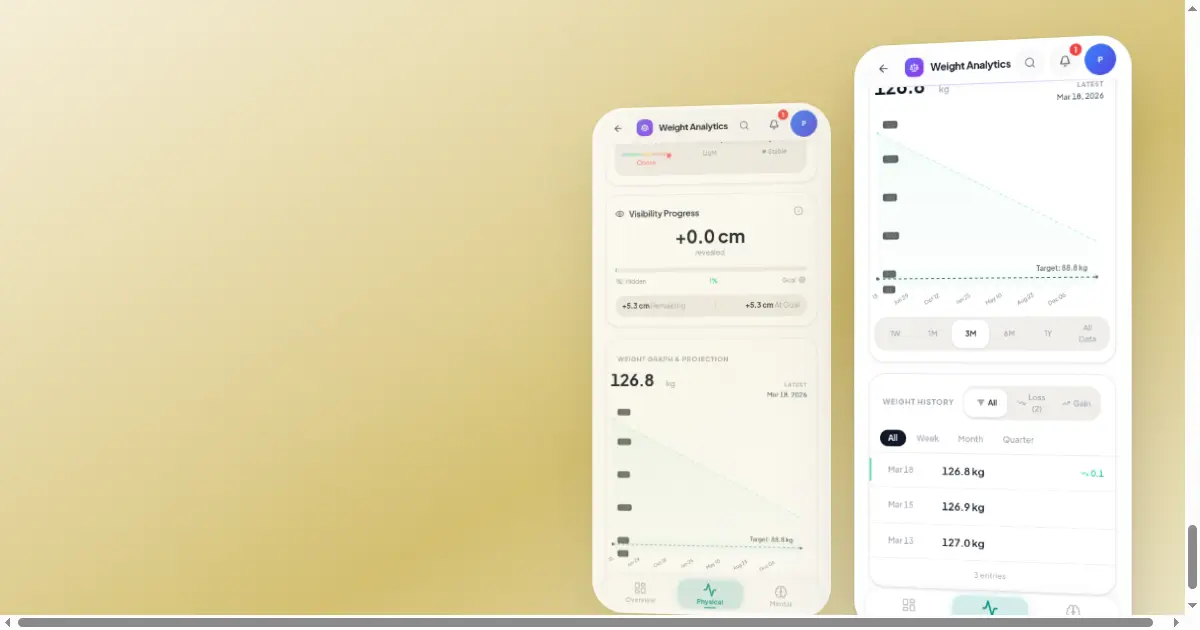
In WatchMyHealth, the weight tracker is designed around this science:
- Daily logging captures every data point, giving the moving average enough data to work with
- The 7-day moving average line on your chart visually separates signal from noise — you can literally see the smooth trend beneath the daily zigzag
- Trend-based projections use your actual rate of change (not single readings) to forecast your trajectory toward your goal
- Multiple time windows (1 week to all time) let you zoom out when a single day's reading feels discouraging
The scale is a measuring instrument, not a judge. Once you understand the physics and physiology behind the number, you stop fearing it — and start using it as the powerful tracking tool it actually is.